
Freeports
Forth and
Inverness – Cromarty

An investment zone is a designated region that can house a freeport airport, towns and entire cities and rural areas under a privately governed authority.
Think of an investment zone as a room within a room, a state within a state, or a party within a party. The UK post Brexit is now like a Russian doll.
Unregulated. Outwith state and local controls.
Unlawful implementation ?
Scotland’s Freeports and Enterprise Zones have fallen far short of their ambitious promises, revealing a stark disconnect between optomistic projections and reality.
Profit sharing favours the private sector. in Forth, 85% of profits from land development have gone to private firms.
Created with secondary legislation with statutorry instruments (SIs) facing minimum scrutiny.
Power remains with Westminster. The Scottish government introdcued “Green Freeports”, the conditions of which can be overruled by Westminster at any time.
Turbocapitalism trampling democracy?
Scotland’s Freeports and investment zones threaten to irreversibly damage local communities, transferring public wealth into private hands while eroding democracy.
25 year contracts and long-term implications including legal challenges if contracts breached.
So what’s the problem
Freeports – advantages
provide specific benefits like low tariffs, optimised customs processes, and a business friendly framework that stimulates local economies and attracts global players.
Investment zones (previously SEZ)- advantages
Are strategically established to boost economic development through innovative regulations, enticing tax perks, and robust support systems that enhance international commerce. Similar to the rules in freeports.
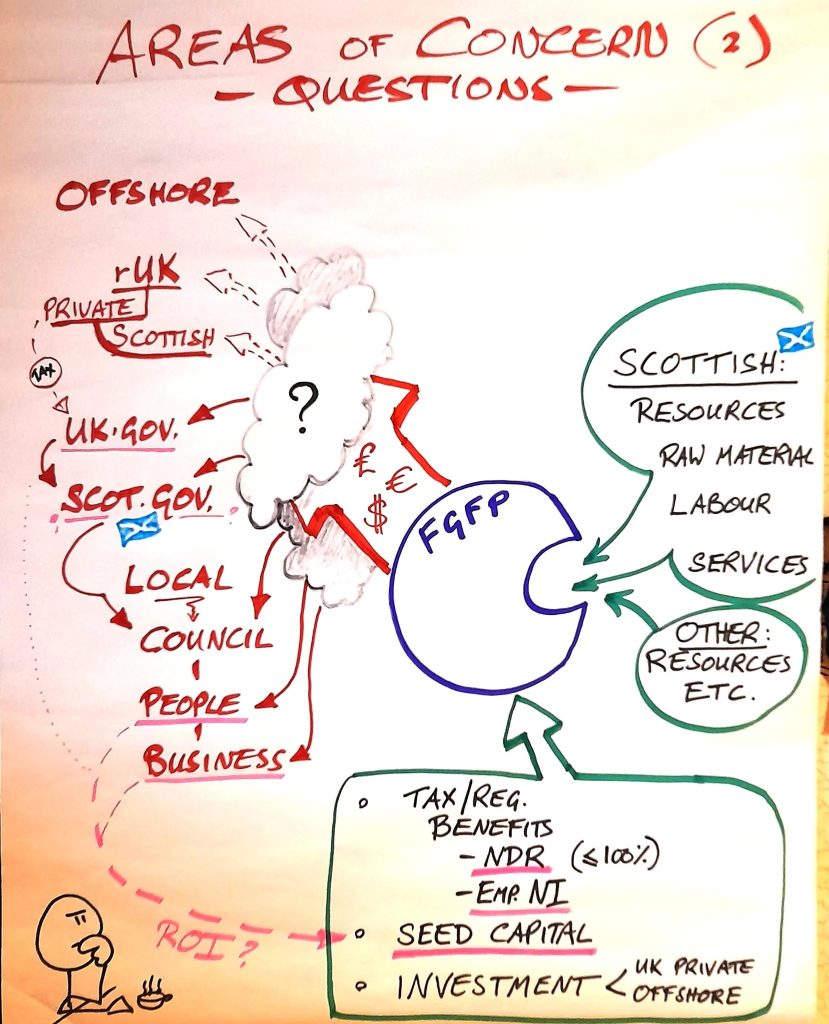
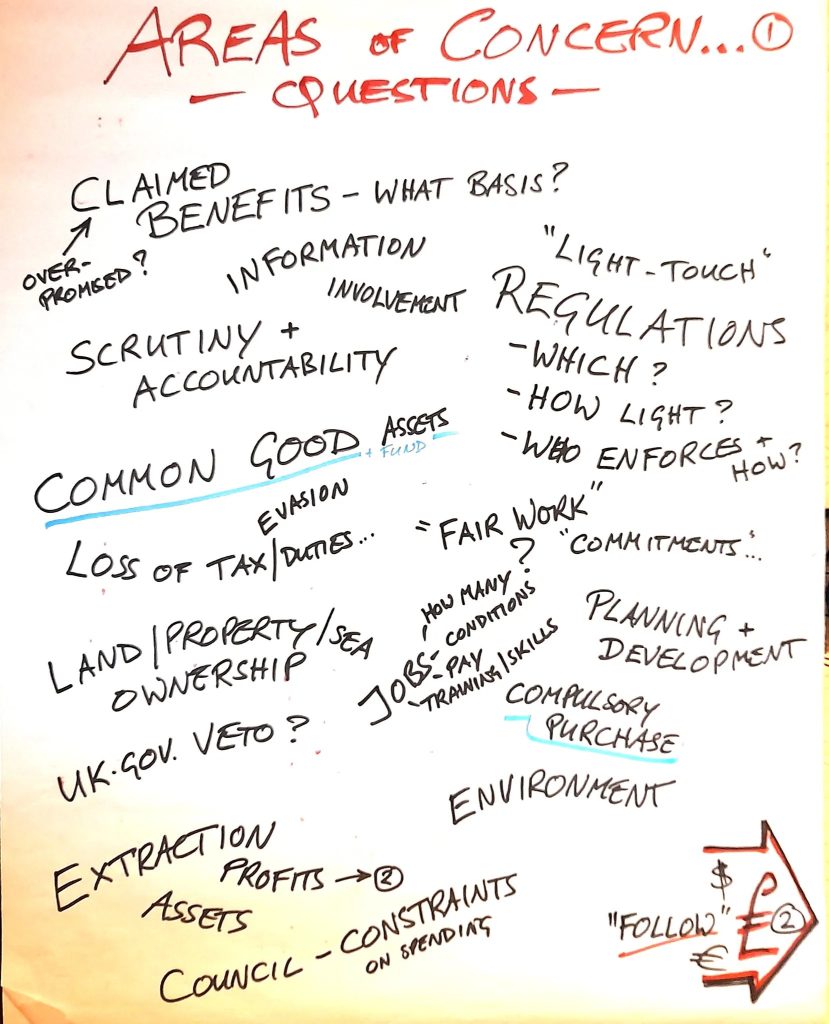
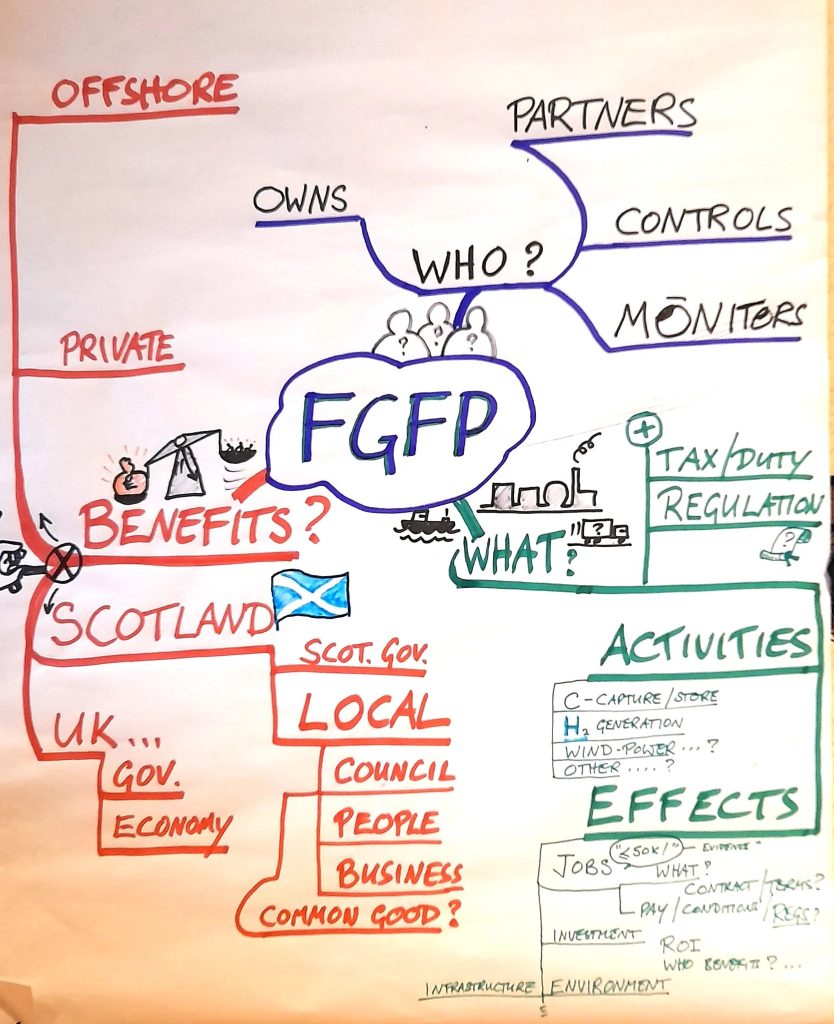
But what benefit to the local economy. What safeguards. What accountability?
Will they deliver on their promises of economic regeneration, particularly in post Brexit Britain?
Previous experience with big projects like this suggest not. They can benefit thee people if correctly controlled and organised. However, people’s trust in government is low, and the people must hold our elected representatives to account.
We are raising the awareness of everyone in Scotland to the potential risks and consequences of each government regime being introduced right across the United Kingdom. They are surrounded in secrecy.
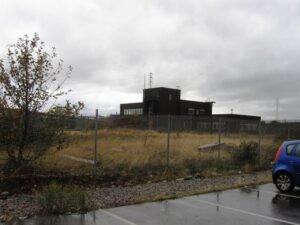
Teesworks in Teesside provides an important case study of the risks that can arise when substantial public funding, publicly supported land development and private commercial interests are brought together within special economic zones.
The former Redcar steelworks site forms part of the Teesside Freeport and has received very substantial public investment intended to regenerate industrial land, attract new businesses and create employment.
However, the relationship between the public South Tees Development Corporation (STDC) and private interests involved in Teesworks has attracted considerable scrutiny.
That’s enough for the opening. We don’t need to hit visitors with the financial detail immediately.
Private Eye reported in August 2026 that more than £600 million of public money had been committed to the redevelopment project. Its investigation raised questions concerning land transactions, payments between the public South Tees Development Corporation (STDC) and Teesworks Ltd, undocumented debts and the accuracy of financial reporting.
Among the transactions examined was the acquisition by private interests of a large plot of land in 2022 for £96.79 plus VAT. Private Eye reported that the land was subsequently made available for the SeAH wind turbine development, generating a £65 million profit.
The investigation also examined STDC’s accounting for its financial relationship with Teesworks Ltd. Private Eye reported that figures supplied for payments between the organisations were revised several times following enquiries, resulting in discrepancies it calculated at approximately £23 million.
The central question.
The issue is not simply how much public money was invested. The important questions are what happened to the resulting value, who carried the financial risk and whether the governance arrangements adequately protected the public interest.
Concerns surrounding Teesworks led the UK Government to commission an independent review in 2023 into the oversight of the South Tees Development Corporation (STDC) and the Teesworks joint venture.
The review reported in January 2024. Importantly, it found no evidence of corruption or illegality.
That finding should not be overlooked.
However, the review identified significant concerns about governance, transparency, decision-making and the management of public assets. It concluded that the arrangements did not provide sufficient transparency and oversight to demonstrate value for money.
The review made a series of recommendations intended to improve governance, financial management, transparency and oversight. The UK Government subsequently issued a Best Value Notice to the Tees Valley Combined Authority in 3 April 2025, requiring improvement action in response to the review.
Official source: UK Government — Independent Review: Teesworks Joint Venture
Teesworks does not need to be described as corrupt for it to raise serious questions about governance. The Government’s own independent review identified weaknesses sufficiently significant to require extensive recommendations for improvement.
The importance of Teesworks is not simply what happened at one site. It is what the experience tells us about the safeguards needed wherever substantial public resources and private investment come together.
Freeports, Investment Zones, AI Growth Zones and similar economic development areas can involve substantial public investment, tax incentives, publicly supported infrastructure and land, private developers and investors, and financial arrangements that may continue for decades.
None of these things is inherently improper.
But together they make transparency, effective governance, independent scrutiny and clear public accounting essential.
How much public money has been committed?
Where has that money gone?
Who owns the resulting assets?
Who carries the financial risk?
Who receives the financial benefit?
Who is ultimately accountable?
These are basic questions of public accountability. They should be capable of being answered clearly wherever public money, public assets or public incentives are being used to support private investment.
Teesworks demonstrates why these questions should be asked at the beginning of an economic development programme — not only after problems emerge.
Scotland is Not For Sale does not suggest that what happened at Teesworks is happening in every Freeport, Investment Zone, AI Growth Zone or other special economic area.
Nor does the evidence justify such a conclusion.
Our concern is that governance and transparency arrangements should be strong enough to ensure that problems of this kind cannot develop unnoticed.
That is why we monitor not only what governments and development bodies promise these zones will deliver, but also their governance structures, public funding, reporting arrangements and the evidence eventually published about what they actually deliver.
Teesworks is therefore a case study we will continue to follow.
As further authoritative evidence, audited accounts, official reviews or other significant information becomes available, this case study will be updated.
The Teesworks case has been examined through official reviews, financial reporting and investigative journalism. The sources below are provided so readers can examine the evidence and differing interpretations for themselves.
Official evidence
UK Government — Independent Review of the South Tees Development Corporation and Teesworks Joint Venture (January 2024)
The Government-commissioned independent review examined governance, finance, value for money, risk and reward between the public and private sectors, land transactions and external scrutiny.
Its central finding is particularly important to our case study: the panel found no evidence supporting allegations of corruption or illegality, but found governance and transparency problems and concluded that existing arrangements lacked sufficient transparency and oversight to evidence value for money.
UK Government — Independent Teesworks Review
UK Government — Teesworks Joint Venture Review collection
Investigative reporting
Private Eye — “Plot twisters”, Teesside, Issue 1682 (August 2026)
Reports on STDC’s 2025/26 accounts, land transactions, outstanding payments and financial arrangements involving Teesworks Ltd.
Analysis and commentary
EuropeanPowell — “The Deregulated Free Zone Is What the Clearance Was For” (24 August 2026)
Analysis of the Teesworks financial and governance issues and their possible significance for the wider UK economic-zone model.
EuropeanPowell — “Sunak Built Teesside Freeport. Now He Advises Anthropic” (29 August 2026)
Examines the subsequent proposed AI Growth Zone development and Rishi Sunak’s advisory relationship with Anthropic.

What can you do?
Navigate to the section that interests you. Come and delve deeper into our vision for the damage these freeports and investment zones will have on the local economy where the claim being made by the winners of the tax havens will not be realised.
Stay updated:
Join us in exploring the impact of Freeports, investment zones, and/or energy.
Unlock insights on economic zones and their risks
Discover how these changes affect your community
engage with initiatives that advocate for fair policies
All 12 freeports, 74 SEZs, and 200 AI Growth Zones were rubber-stamped initially under primary legislation, but secondary legislation was quickly implemented meaning the policy was not debated in Parliament, the public were cut out of the decision/notification process, and the Press including the Independent Media, were completely sidelined.
This is why no one has heard of investment zones, and why the MSM is not reporting it.
Public infrastructure is under attack from the duopoly and 700 corporations, including Blackrock, Blackstone, Deloitte, PEEL Group, Palantir, Vanguard, Chevron, and hundreds more.
This scale and offshoring presence suggest a strategic structuring consistent with minimising transparency and regulatory oversight. Blackrock bought edinburgh airport, the ports of Helixstowe, Thamesport and Harwich. They currently hold 677 registered entities at companies house, with many listing Cayman island addresses. The scale and offshoring presence suggest a strategic structrinjg consistant with minimising transparency regulatory insight.
(@EuropeanPowell on substack and X)
Should we be worried ? YES !!!!!!
info@scotland-notforsale.scot